Welcome to the Mathematical World!
Zeno of Elea
The Master of Paradox (c. 490 BCE – c. 430 BCE)
Background
Zeno of Elea was a Greek philosopher and a devoted student of Parmenides, the great thinker of the
Eleatic
school.
He is most famous for his paradoxes, which challenged common sense and defended Parmenides’ doctrine
that
reality is
one,
unchanging, and motionless. Aristotle later called Zeno the “inventor of dialectic” because of his skill
in
logical
argumentation.
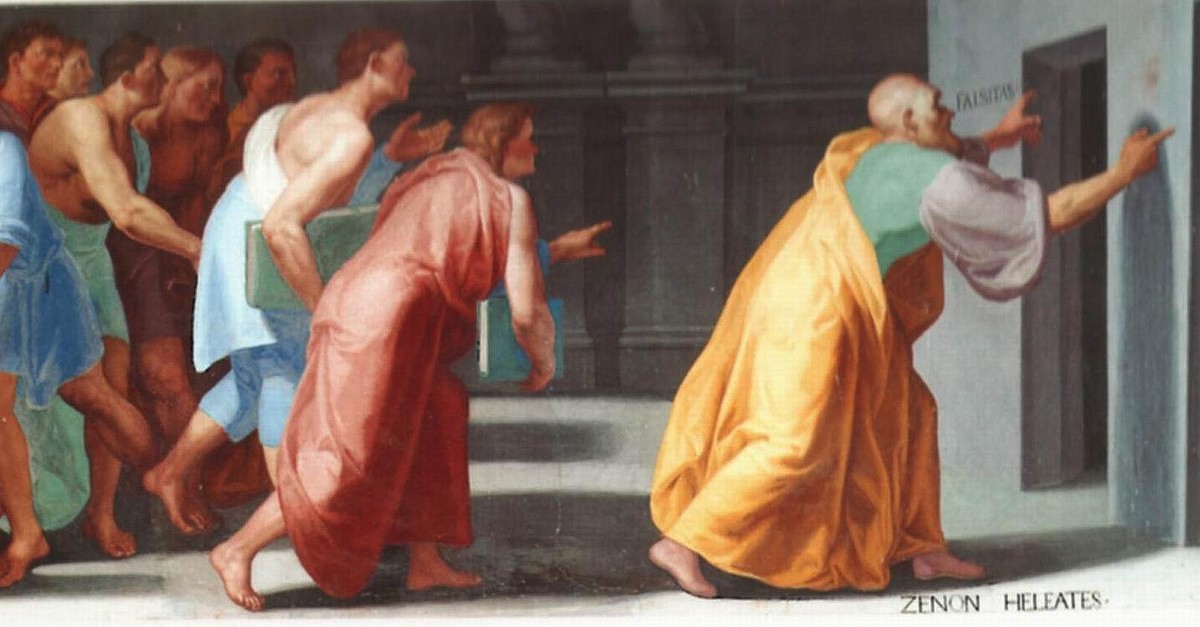
Zeno was born in Elea, a Greek colony in southern Italy. He studied under Parmenides and worked to defend his master’s radical philosophy. Parmenides had argued that change and motion are illusions — reality is a single, eternal, unchanging whole. To support this, Zeno crafted logical paradoxes that exposed contradictions in the belief that motion, plurality, or time are real.
Zeno’s Paradoxes
Zeno is best remembered for his famous paradoxes, which remain subjects of philosophical and mathematical debate:
The Dichotomy Paradox
To travel from point \(A\) to point \(B\), one must first cover half the distance, then half of the
remaining
distance,
and so on infinitely. Therefore, motion seems impossible because it requires completing infinitely many
steps.
Equation form:
\[ \text{Distance} = \frac{1}{2} + \frac{1}{4} + \frac{1}{8} + \frac{1}{16} + \cdots \]
Modern mathematics resolves this by showing that the infinite series converges:
\[ \frac{1}{2} + \frac{1}{4} + \frac{1}{8} + \cdots = 1 \]
Achilles and the Tortoise
In a race, Achilles gives a tortoise a head start. By the time Achilles reaches the tortoise’s starting
point,
the tortoise has moved a little further ahead. This continues infinitely, so Achilles can never catch
the
tortoise.
The Arrow Paradox
At any single instant of time, an arrow in flight occupies a fixed position.
Since time is made of such instants, the arrow is always at rest, and thus motion is impossible.
The Stadium (Moving Rows)
This paradox questions whether motion and time can be measured consistently, suggesting contradictions
when equal speeds and distances are compared.
Purpose of the Paradoxes
Zeno did not deny the appearance of motion. Instead, his paradoxes were arguments against the reliability of the senses and in favor of Parmenides’ philosophy that reality is indivisible and unchanging. His goal was to show that believing in plurality or motion leads to absurdities.
Influence and Legacy
Philosophy: Zeno’s paradoxes forced later philosophers to refine their logic and metaphysics. Aristotle devoted much thought to answering them.
Mathematics: The paradoxes anticipated modern ideas of infinity, limits, and calculus. In particular, the Dichotomy paradox connects directly to the modern concept of convergent infinite series.
Modern Thought: Even today, Zeno’s paradoxes are discussed in philosophy of mathematics, physics, and time.
Legacy
Zeno of Elea is remembered as one of the greatest philosophical provocateurs of antiquity. By crafting paradoxes that exposed contradictions in common beliefs about motion and plurality, he deepened humanity’s understanding of infinity, continuity, and logic. His puzzles still inspire debate, showing that philosophy can begin with a single clever question that challenges the very foundations of thought.

All rights reserved by the Mathematical Unity
Contact: +8801400044645
Email: mathematicalhorse1453@gmail.com
Our Discord Server: Mathematical Unity [Ulus Riyadiyat]